
A male buffalo is a powerful, rugged beast. Edgy, angry and always ready for a fight. But what a magnificent creature.
Saturday, July 2, 2011


Wednesday, May 18, 2011
Slow Forest River
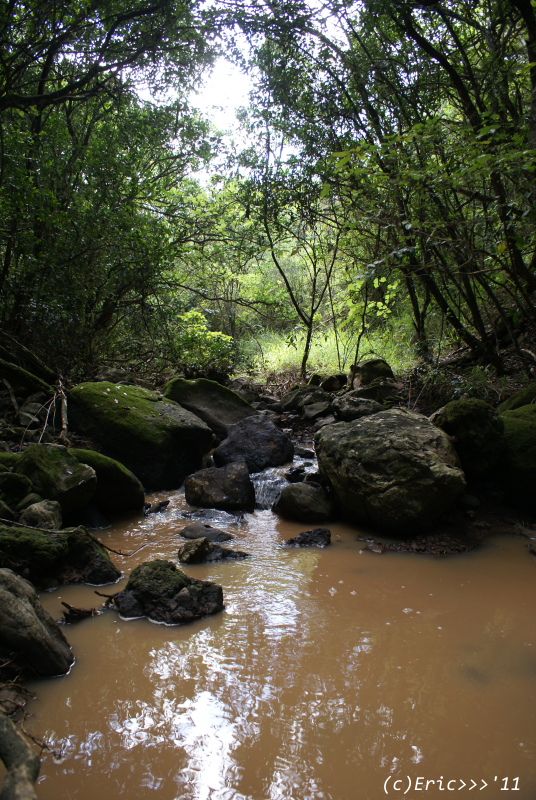
Deep in the forest
Sunshine through the trees
Lights the slow river
And mossy green rocks
Monday, May 16, 2011
Under Papyrus
Papyrus (Cyperus papyrus) is a wetland plant that mankind has used for millenia. The ancient Egyptians found diverse uses for it including making paper, boats, baskets and even as food. Certain birds use its flowering heads for nesting.

A dense stand of papyrus grows along the Mbagathi river in Oloolua Forest, towering up to three metres above the ground.

A dense stand of papyrus grows along the Mbagathi river in Oloolua Forest, towering up to three metres above the ground.
Wednesday, May 11, 2011
Oloolua's Spooky Stairs
Oloolua Forest is one of those hidden treasures of Nairobi. Tranquil, scenic and easily accessible, it is perfect for a quickie nature hike or a more leisurely nature experience that could include bird watching, a picnic, exploring an ancient cave and myriad other treats. It is also the site of this steep, spooky staircase.

There's much to write about this wonderful place.

There's much to write about this wonderful place.
Monday, May 2, 2011
Eburu: Hidden in Plain Sight

As you drive into Naivasha from Nairobi, your view is drawn to a mountain that dominates the landscape to the north. This is Mt. Eburu, the easternmost extension of the Mau Range. Eburu stands alone, bordered by Lake Naivasha to the south, the Mau escarpment to the west and Lakes Elementaita and Nakuru to the north and north-west respectively. Its highest peak, Ol Doinyo Opuru, stands over 2,700 metres above sea level. The mountain is a long massif of undulating peaks aligned east-west that towers above the surrounding landscape.

Eburu, though rich in biodiversity, is not well known as a recreational destination. It is overshadowed by the ever popular Naivasha area. The magnificent Great Rift Valley Lodge and Golf Resort is likely its only ‘tourist class’ recreational facility. Occupying a large area of the mountain, the Eburu Forest reserve is said to cover 8,715 hectares. Within this forest are myriad wildlife including a small population (7-12 animals) of the critically endangered eastern mountain bongo antelope (there are less than 100 left in the wild). There is plentiful birdlife, including raptors such as the black-shouldered kite.
A narrow track traverses the forest starting at the Eburu Forest Station, and the locals use this to access the forest to collect firewood and graze their livestock.


The indigenous forest is tranquil and beautiful, showcasing tall trees and leafy undergrowth. Moorland vegetation can be observed in forest glades at the higher elevations.

The mountain offers spectacular views of the surrounding Rift Valley landscape from every side – it is a scenic tour de force.

Underfoot, Eburu is geologically active. Geothermal wells have been developed in the forest to harness the power that lies beneath. In the foothills around the Ndabibi area the locals speak with awe of the way the ground subsides from time to time, leaving yawning crevasses large enough to swallow an entire house.
 |
| geothermal well - capped for now |
 |
| terra not firma - geology at fault |
Saturday, April 30, 2011
Makalia River Hits Rock Bottom
The Makalia River rises in the Eastern Mau escarpment and flows east, and then north, into the southern end of Lake Nakuru. It is a key water source, together with Rivers Njoro and Nderit that drain into the lake from the Mau. En route, it drops into the Lake Nakuru basin via the scenic Makalia Falls, a popular tourist site in the Lake Nakuru National Park. The permanent flows of the river have traditionally guaranteed a great viewing experience for visitors, with the roaring falls providing accompaniment to birdsong, the bark of baboons and other wildlife sounds.
But dark clouds of uncertainty hang over the future of the Makalia River. In recent years, it has dried up on various occasions, as a visit to the falls over Easter 2011 revealed.
It is clear that efforts to rehabilitate the Mau need to be stepped up, urgently, to protect the river and the Lake that depends on it...
But dark clouds of uncertainty hang over the future of the Makalia River. In recent years, it has dried up on various occasions, as a visit to the falls over Easter 2011 revealed.
 |
| Waterfall - no more |
 |
| Downstream - dry river bed |
Wednesday, April 27, 2011
Baboon In Chief
 |
| Jungle Throne - King Surveys Domain |
A full-grown male olive baboon (Papio cynocephalus anubis) is a fascinating creature. It stalks through its habitat with purpose, King of all it surveys and unafraid of man or beast. Its long snout holds powerful jaws and long, wickedly sharp canine teeth. Its barrel-like chest suggests real power, and its long arms are as adept at climbing as they are at snatching food from the unwary tourist.
I came face to face with this magnificent specimen, the dominant male of the troop, at the aptly named Baboon Cliffs view point in Lake Nakuru National Park. The shaggy beast engaged me in a brief staring contest. Realising that I had nothing to offer, it quickly lost interest and calmly resumed its survey of the picnic site, searching for unguarded food items.
Baboons are interesting animals to observe but also genuinely dangerous if not treated with the respect due any wild animal. They are age and gender sensitive: they will confront women and children without hesitation, but will usually keep a respectful distance from adult men. Interestingly, they can distinguish gender regardless of clothes worn!
Baboon Viewing Tips:
- Observe them at a respectful distance
- Do not offer food under any circumstances
- Do not leave food items unattended
- Never leave your car unattended with doors or windows open
Subscribe to:
Posts (Atom)

